Nesting activity in the East Valley shifts rapidly between open-air paper wasp umbrellas and concealed honey bee colonies embedded inside building envelopes. In master-planned developments like Fulton Ranch, Ocotillo,…
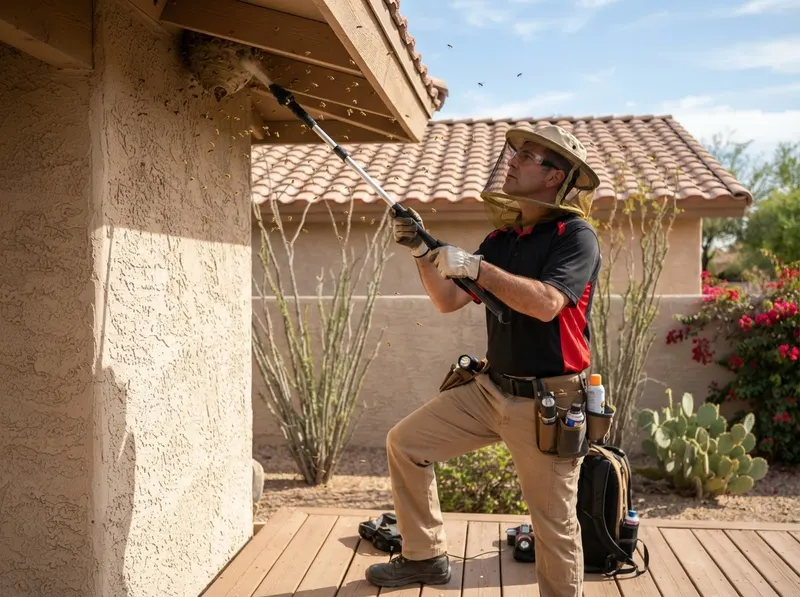
Nesting activity in the East Valley shifts rapidly between open-air paper wasp umbrellas and concealed honey bee colonies embedded inside building envelopes. In master-planned developments like Fulton Ranch, Ocotillo, and Carino Estates, paper wasps frequently anchor small brood combs along stucco eaves, patio beam joins, and pool equipment enclosures. These external nests present an immediate sting hazard near outdoor living zones, but simple aerial knockdowns leave lingering orientation pheromones that draw new queens back to the same perimeter bracket. Grounded treatments require treating the anchoring point and neutralizing residual attractants. Honey bees present a more severe structural problem when foraging scouts find gaps under clay roof tiles, unmeshed weep screeds, or utility conduit penetrations. A colony settling into an exterior wall cavity can deposit 10 to 20 pounds of wax and honey within three weeks, creating secondary moisture damage and attracting secondary desert pests like wax moths and foraging ants.
Selecting treatment options depends directly on whether the colony occupies an open surface or a closed structural pocket. If an exposed wasp comb hangs beneath an eave in Clemente Ranch or Sun Groves, an exterior application neutralizes the active adults immediately without opening walls. If an established bee colony enters a parapet wall or chimney flashing in Circle G at Riggs Homestead or Andersen Springs, topical perimeter spraying only kills the surface guard bees, leaving the hidden brood and honey mass inside to ferment and melt in Maricopa County summer heat exceeding 105 degrees. In these closed-cavity situations, structural cut-out or vacuum extraction is required to extract the comb entirely, followed by installing galvanized steel mesh over the void to physically exclude future swarms. The trade-off between exterior misting and cavity cut-out involves repair scope: surface treatments avoid drywall or stucco cuts, whereas full comb extraction requires temporary material opening to prevent recurring rot, staining, and re-infestation.
Homeowners can coordinate service through a direct three-step procedure: 1. Phone intake at (877) 714-9707 documents the exact hive location, elevation, and proximity to occupied doors or air conditioning returns. 2. A technician inspects the exterior envelope using thermal or acoustic scanning to map the exact boundary of the internal comb without unnecessary structural damage. 3. The colony is neutralized, the wax structure is removed, the interior pocket is treated with an enzyme deodorizer, and entry gaps larger than one-eighth of an inch are sealed.
Every job gets a firm, written price after a free on-site visit.
Tell us about your wasp & bee removal job in Chandler and we'll send a clear, written quote, usually the same day.
 Desert Sparrow Pest Control