Desert mosquito pressure in Maricopa County intensifies dramatically between April and October when monsoon rains and residential irrigation create isolated pools of stagnant water. Subdivisions near artificial lakes…
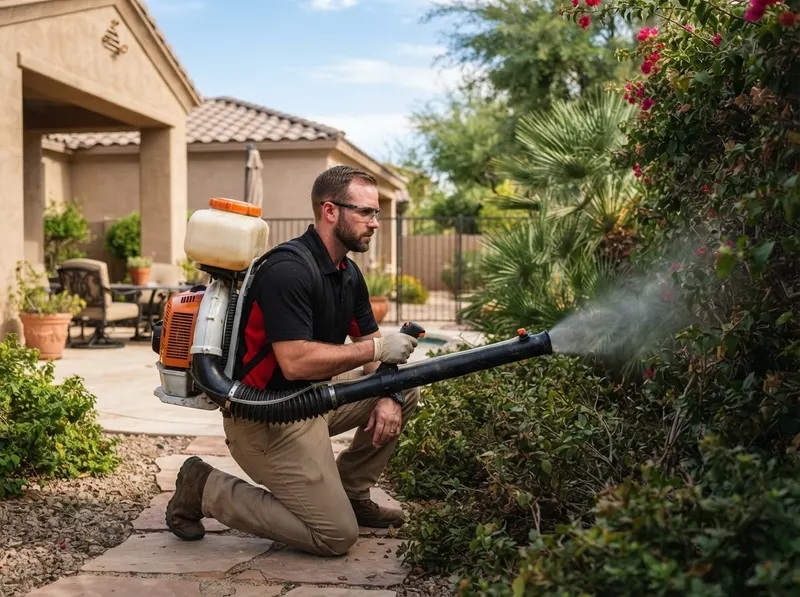
Desert mosquito pressure in Maricopa County intensifies dramatically between April and October when monsoon rains and residential irrigation create isolated pools of stagnant water. Subdivisions near artificial lakes and dense greenbelts, such as Ocotillo, Fulton Ranch, and Andersen Springs, often experience rapid population surges of both Culex and Aedes aegypti varieties. While desert ants and scorpions demand physical perimeter exclusion, mosquito defense requires interruptive biological controls that break the 7-to-10-day reproductive cycle. Instead of relying on broad, indiscriminate chemical washes, modern treatment plans map specific microclimates on the property, targeting French drains, potted plant saucers, drip irrigation manifolds, and shaded underside leaf canopies where heat-stressed adults shelter during daylight hours.
Selecting the right outdoor control method depends on property topography and water exposure. If an outdoor space features expansive turf, shaded ramadas, and heavy citrus foliage, backpack misting provides an electrostatic residual barrier that adheres to the undersides of leaves, delivering 21 to 30 days of continuous reduction. If a property in Circle G at Riggs Homestead or Carino Estates features standing water basins, unchlorinated water features, or low-grade drainage easements, microbial larvicide applications using Bacillus thuringiensis israelensis (BTI) are mandatory. The trade-off centers on coverage longevity: foliage barrier sprays neutralize resting biting adults immediately upon contact, while BTI larvicides prevent the emergence of new flying broods without disrupting non-target aquatic life or domestic pets.
A common misunderstanding among homeowners in Clemente Ranch and Cooper Commons is that municipal street fogging performed by county vector control resolves localized yard infestations. County fogging only neutralizes airborne adults caught in the direct public road drift at the moment of release; it does not penetrate private rear yards, covered patios, or dense desert landscaping. For properties bordering regional parks like Tumbleweed Park or Veterans Oasis Park, active irrigation creates recurring damp soil beds. A standard three-step defense restores backyards efficiently: 1. Technicians inspect the perimeter to eliminate hidden stagnant water collectors and apply slow-release biological tablets to retention areas. 2. A calibrated, micro-encapsulated treatment is misted into perimeter shrubs, block-wall ivy, and sheltered eaves. 3. Homeowners receive a tailored drainage blueprint to manage HVAC condensate lines and automated sprinkler pooling permanently.
Every job gets a firm, written price after a free on-site visit.
Tell us about your mosquito control job in Chandler and we'll send a clear, written quote, usually the same day.
 Desert Sparrow Pest Control